
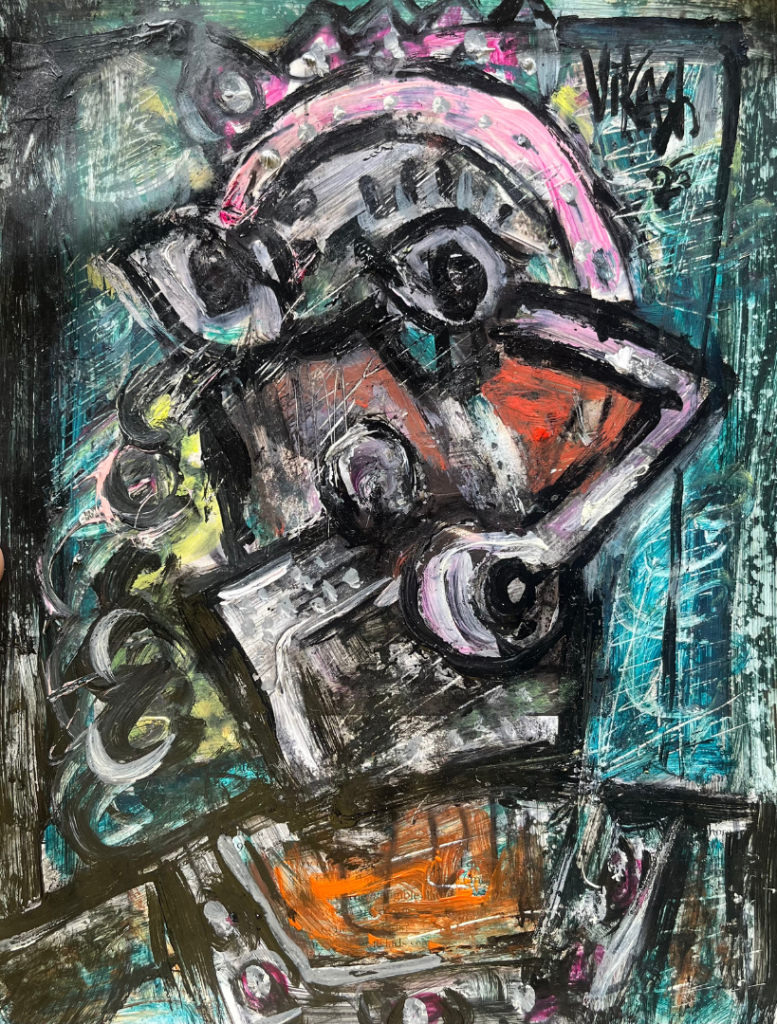
In the vibrant, often rule-bound world of contemporary Indian art, Vikash Kalra stands apart as a compelling outlier. A self-taught artist whose path led from commerce to canvas, Kalra has carved a distinct identity through his raw, visceral, and profoundly textured abstract expressionism. His art is not simply seen—it is felt, unfolding as a spontaneous eruption of chaos and calm.

What truly distinguishes Kalra is his fearless embrace of mixed media and his use of chemical alteration techniques—a process that transforms the canvas from a flat visual field into a living, reactive surface. Through this alchemical practice, Kalra converts matter into metaphor, surface into soul.
The Philosophy of Rawness and Process
At the heart of Kalra’s art lies a meditative philosophy—one that values instinct over intellect, process over perfection. He approaches painting as a spontaneous dialogue with emotion and spirit, surrendering to the unpredictable flow of creation.
As he reflects, “I lose myself in the process. I let things break, let them get chaotic, let the canvas get muddy. I believe great process creates great paintings.”
This embrace of entropy—the beauty in disorder—forms the philosophical foundation for his material experimentation. His oils, acrylics, inks, and pastels are not mere colors; they are vehicles for transformation, chosen for their ability to react, resist, and evolve. The painting becomes a visible record of this struggle, breakdown, and rebirth.
Chemical Alteration: Forging Texture and Time
Kalra’s process of chemical alteration reflects a deep understanding of time, decay, and renewal. These techniques are not about scientific control, but about invoking the forces of nature—erosion, corrosion, oxidation—to bring life to the surface of the canvas.
Through controlled reactions, Kalra creates cracks, burns, bleeds, and patinas that mimic the slow processes of weathering and aging. The result is a tactile, almost geological surface that speaks of time’s passage and emotional endurance.
The Role of Reaction and Patina
Corrosive Elements:
Using carefully diluted solvents, acids, or oxidizing agents, Kalra distresses the surface, creating fissures and peeling effects that feel ancient and organic. The resulting patina is not painted—it is grown.
Solvent Washes and Breaks:
Layers of oil or acrylic are broken down with turpentine, mineral spirits, or alcohol, allowing pigment to separate and flow unpredictably. This “muddy chaos” is intentional—an embrace of nature’s randomness as collaborator.
Oxidizing Metals:
Metallic powders such as iron or copper are introduced and treated with chemical agents to accelerate rust or verdigris formation. Time itself becomes embedded within the artwork, giving the piece a weathered, earthly presence.
The chemical process becomes a metaphor: each scar and fracture on the canvas mirrors the artist’s emotional excavation. Through decay, Kalra finds renewal. Through destruction, he finds creation.
The Expansion into Mixed Media
Kalra’s mixed media work transforms the two-dimensional canvas into a sculptural field—a terrain of matter, energy, and emotion. These surfaces invite not just vision, but touch and contemplation.
Building a Textured Landscape
Inorganic Additives:
Sand, marble dust, plaster, and cement are embedded within the paint, forming dense impasto layers that catch light and shadow. These materials respond vividly to chemical treatments, creating unpredictable interactions.
Collage and Assemblage:
Fragments of paper, metal foils, fabric, and ink drawings are integrated into the surface—partially obscured, partially revealed. Like remnants of memory or ancient frescoes, they evoke the persistence of the past within the present.
Ink on Canvas and Paper:
Fluid ink meets roughened, chemically altered surfaces, creating organic bleeds and calligraphic gestures that heighten contrast and tension.
Here, material and metaphor converge. The mixed media provides physical form; the chemical transformation gives it soul. Together, they create a visual and emotional topography unlike any other in Indian abstraction.
Emotional Resonance and Artistic Impact
Through these radical processes, Kalra achieves an emotional depth that transcends aesthetic appeal. His canvases, scarred and luminous, confront viewers with the beauty of imperfection and the inevitability of transformation.
Each work becomes an emotional landscape—reflecting chaos, stillness, pain, and hope in equal measure. The act of chemical breakdown mirrors the emotional deconstruction within the artist: a necessary surrender before renewal.
Rooted in his practice of yoga and meditation, Kalra approaches creation with detachment and trust. He allows instinct and intuition to lead, letting the artwork evolve through both accident and awareness.
What emerges is not destruction but rebirth. A canvas once subjected to harsh elements radiates unexpected vitality. Through the alchemy of material and emotion, Kalra transforms corrosion into creation, entropy into expression.
Conclusion: The Beauty in the Breakdown
Vikash Kalra’s art is a study in transformation—of materials, emotions, and perception. By fusing chemical alteration with mixed media, he turns painting into a living process of becoming.
His canvases, with their textures of time and layers of feeling, remind us that creation often begins where control ends. In Kalra’s hands, the breakdown is not an end—it is where art begins.